Innovative Satellite Technology from OHB with Thermal Protection made by HPS
March 2026







Innovative Satellite Technology from OHB with Thermal Protection made by HPS
March 2026
Three inconspicuous letters stand for technological capabilities without which modern life would come to a standstill: PNT – Positioning, Navigation, Timing. These are abilities that must be constantly developed and optimised. Under the project name “LEO-PNT”, the OHB Group (Germany) together with GMV (Spain) are acting jointly for a demonstration mission in low Earth orbit (LEO) with four new satellites. The aim of this in-orbit demonstration is to test various technical parameters and incorporate the insights gained into a comprehensive LEO-PNT constellation. The innovative LEO-PNT payloads act as amplifiers between the high-flying Galileo satellites and users on Earth. In doing so, they not only optimise existing signals but also expand the range of navigation signals with new frequency bands, signal structures and content. Germany and Spain have been the most important signatories on the ESA Ministerial Conference in November 2025, followed by Italy.
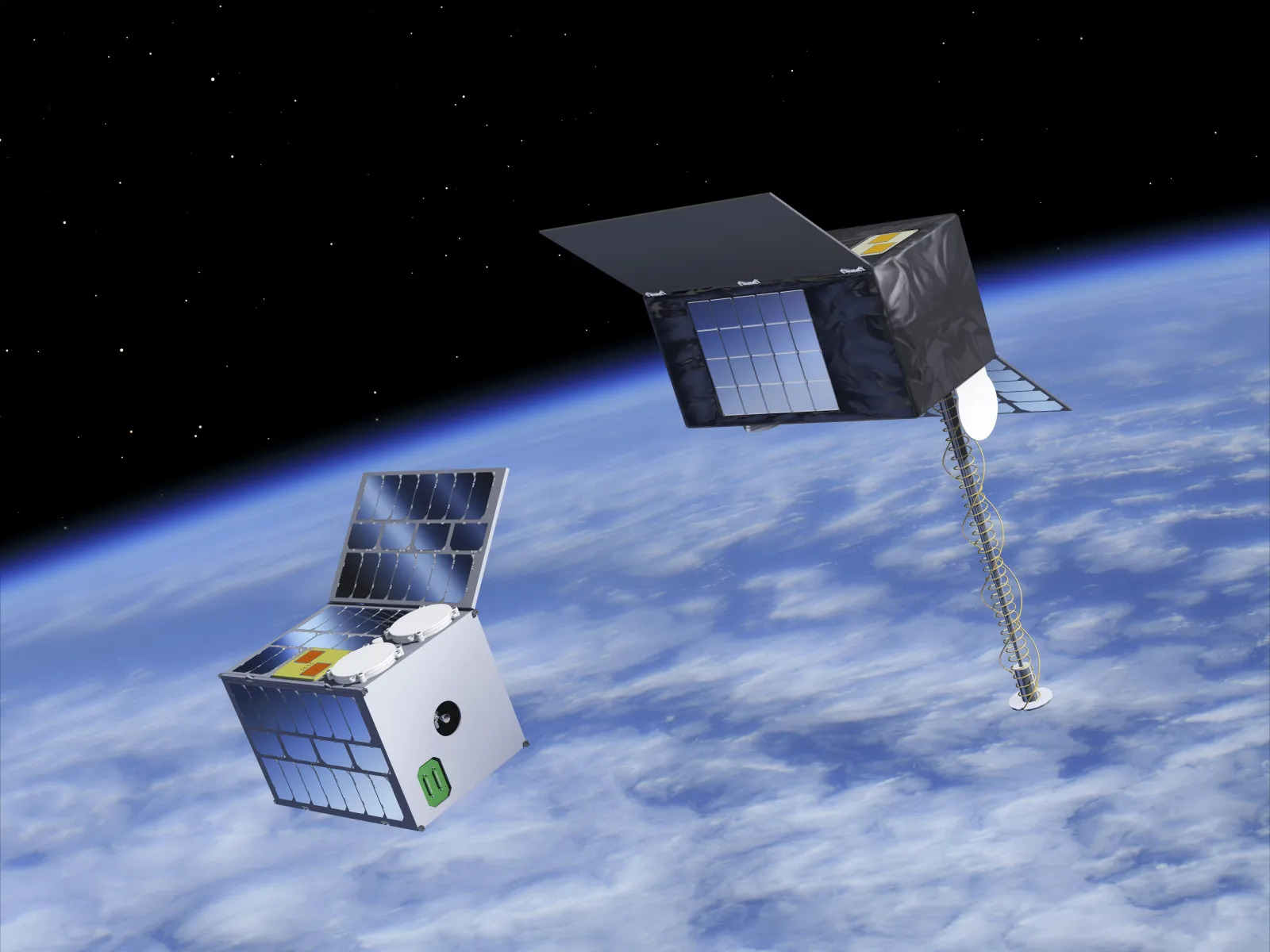
In order to operate reliably under the extreme conditions of space, the four satellites — each about the size of a washing machine-dryer combination — are protected against cold and heat by a multi-layer insulation (MLI). The German specialist HPS GmbH has been commissioned with the design, manufacturing and integration of this insulation. In addition to thermal protection, further safety measures are employed: an ITO coating protects against atomic oxygen (ATOX), while a single layer insulation (SLI) serves as ESD (electrostatic discharge) protection for the solar panels.
HPS is regarded across Europe as a key supplier of thermal hardware in the field of navigation and communication for small satellites, as well as for scientific instruments. The company not only equips now the LEO-PNT satellites, HPS, in collaboration with OHB, was already responsible for the delivery of the MLI on Flight Model 3 of last year’s HIVE project. This close partnership is a clear evidence of the trust placed by the leading German space company OHB in the expertise of HPS, and underscores the strategic importance of strong, SME-based supply chains within the European space industry.
Note: HPS also delivered four of its “ADEO-N” deorbit dragsail modules for the first four LEO-PNT satellites at the end of last year. “To avoid space debris, the design of the LEO-PNT satellites was created to exceed current standards: With the help of their propulsion system and a sail, the satellites will actively leave their orbit shortly after the end of their mission, descend, and eventually burn up in the Earth’s atmosphere.” [Quote BDLI]
Federal Minister Visits Joint Venture HPtex
February 2026
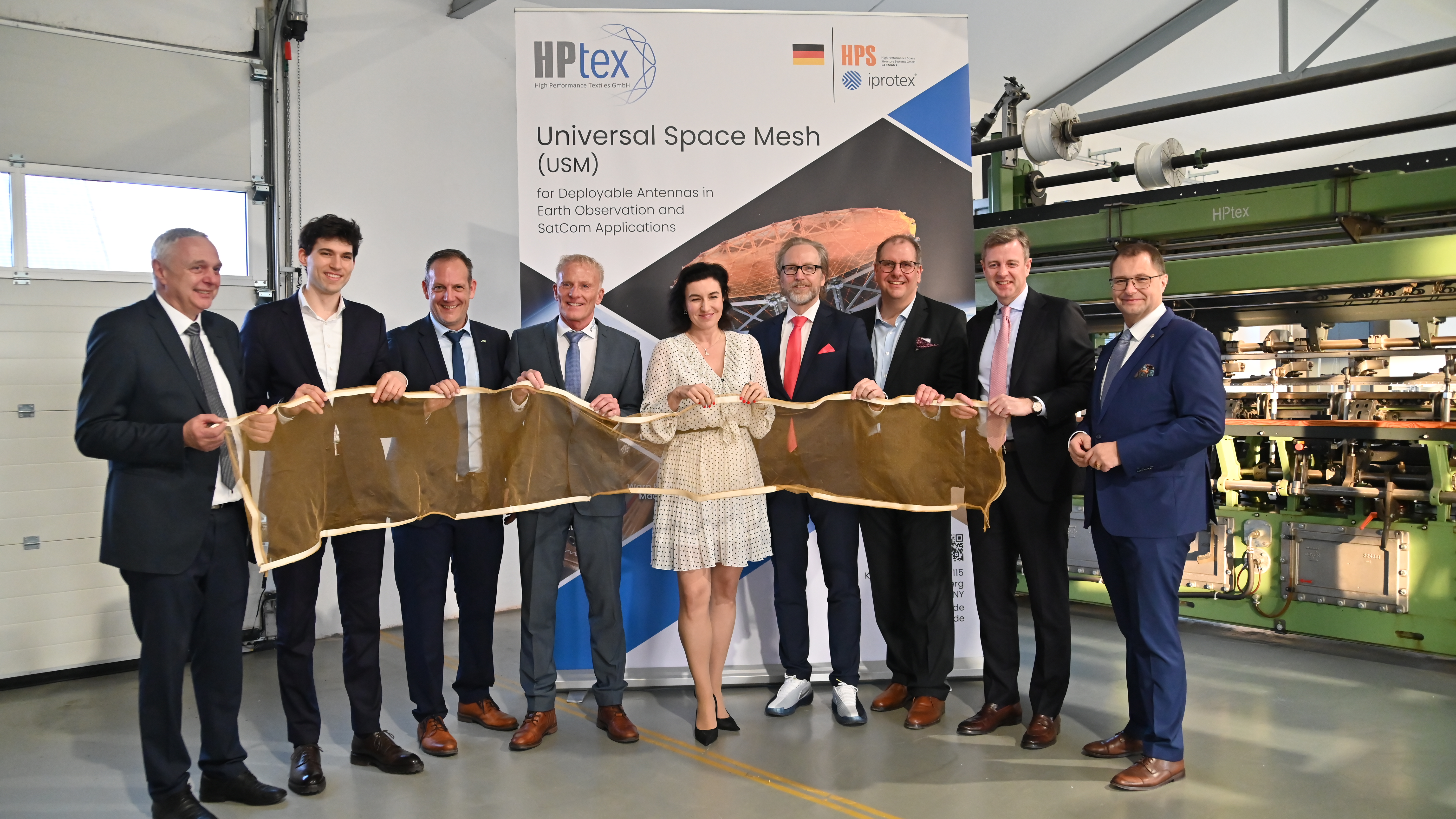
Münchberg, Upper Franconia – The Bavarian-based joint venture HPtex GmbH, founded by HPS High Performance Space Structure Systems GmbH and IPROTEX GmbH & Co. KG, recently welcomed high-ranking political guests to its production site in Münchberg.
We felt honored to welcome the German Minister for Science Technology and Space, Mrs. Dorothee Bär, who came to learn more about the innovative space mesh technologies developed and produced at HPtex. She was accompanied by several regional political representatives, including Member of Parliament MdB Mr. Heiko Hain, District Administrator for Hof, Mr. Oliver Bär, Münchberg mayoral candidate Mr. Thomas Schnurrer, as well as additional local council candidates of CSU. The visit was also attended by numerous citizens from Münchberg.
A special highlight of the gathering was the participation of Prof. Dr.-Ing. Frank Ficker, who played a key role in initiating the early research collaboration on metallic space meshes approximately ten years ago at the Fraunhofer Institute in Münchberg. The event also brought together leading representatives from the joint venture partners, including Timo Piwonski, Managing Director of IPROTEX, and Peter Rauhut, CEO of HPtex and CFO of HPS.
Space Mesh Technology with ESA Heritage:
The ultra-fine metallic meshes developed at HPtex represent a technological success story emerging from several technology programs of the European Space Agency, including TRP, GSTP, ARTES, and Earth Observation (EO) initiatives.
These high-precision meshes combine electrical conductivity with mechanical flexibility and are already being used in advanced space systems such as small deployable antennas and Large Deployable Reflector Subsystems (LDRS). One prominent example is the mesh-application onboard the Copernicus CIMR Mission, which will provide crucial observations for the study of Earth’s polar regions.
Event Program:
The visit program included a welcoming reception at the facility entrance, followed by a standing panel discussion in the preparation hall. Guests had the opportunity to explore various exhibition pieces presented by HPtex, IPROTEX, the Fraunhofer Institute, and fashion designer Laura Theiss.
A dedicated tour of the new mesh production hall provided insight into the highly specialized manufacturing processes used to produce these advanced materials. The program concluded with a group photo and numerous opportunities for discussion, including exchanges between Minister Doro Bär and HPS CEO Dr.-Ing. Ernst K. Pfeiffer.
A Decade of Development in Münchberg:
The roots of HPS’s activities in Münchberg go back around ten years, when the company began collaborating with the Fraunhofer Institute and Professor Ficker on metallic mesh technologies. Building on this cooperation, HPtex GmbH was founded in February 2020 as a joint venture between HPS and IPROTEX.
Today, HPtex has established itself as a globally recognized specialist in high-precision space meshes, supplying the so-called “Universal Space Mesh USM) to customers in Europe, Asia, and the United States. Further product developments beyond mesh technologies are already being explored for the future.
The local newspaper Frankenpost also reported on the visit under the headline “Münchberg bringt Textil ins Weltall” (“Münchberg brings textiles into space”).
HPS and HPtex would like to thank all colleagues and partners involved for the excellent preparation and successful realization of this event.
Two Antenna Reflector Assemblies for LUNAR-GATEWAY
January 2026
Following the completion of manufacturing for all components, HPS GmbH, Germany, successfully concluded the assembly and alignment activities of both models of the Antenna Reflector Assembly (ARA), developed as part of the Ka-Band Steerable Antenna (SKBA) for the LUNAR LINK SYSTEM. Lunar Link is European Space Agency’s advanced telecommunications infrastructure for NASA’s Lunar Gateway, designed to provide critical radio-frequency (RF) communication between the orbiting station and assets operating on and around the Moon, such as rovers, landers, and satellites. The system supports high-data-rate services, including live video transmission. Installed on the Habitation and Logistics Outpost (HALO), Lunar Link incorporates dedicated computers, radios, and antennas, serving as a key communications hub for the Artemis program’s lunar operations.
The main reflector, with a diameter of 1.25 m, was manufactured by machining a single aluminum-alloy block with an initial mass of approximately 1.3 tons, resulting in a final component weighing less than 10 kg. Multiple thermal stabilization steps were introduced during the machining process to relieve internal stresses, ensuring dimensional accuracy, geometric stability, and compliance with tight tolerances both during and after machining.
The alignment activities at HPS’s large new integration hall in Oberhaching (south of Munich, 20 min. by car from HPS Offices) were carried out using HPS’s high-accuracy, contactless laser-radar measurement system, employed to determine the relative position and orientation of the two reflectors (main and sub-reflector). The position of the sub-reflector was precisely adjusted using custom-designed support equipment. The achieved results are well within the stringent requirements defined by our customer chain Sener (Spain), ThalesAleniaSpace (France) and ESA/ESTEC (Netherlands), namely antenna component translations within a sphere of 0.06 mm radius and rotations within a 0.02-degree half-cone angle.
Both reflector assemblies are now safely packed in their respective transport containers and are ready for shipment to our direct customer in Spain.
The budget for the project was initiated already on ESA Ministerial Conference 2019, where Germany has committed for a certain SME-share to the construction of the Lunar Gateway. HPS received the contract for the Antenna Reflector Assembly in 2021. HPS CEO: “To be part of this outstanding international GATEWAY-Program makes us very proud. GATEWAY is another positive example for global collaboration supporting peace on Earth. We hope that we as SME can contribute with further equipment in the frame of robotics on and population of the moon.”
