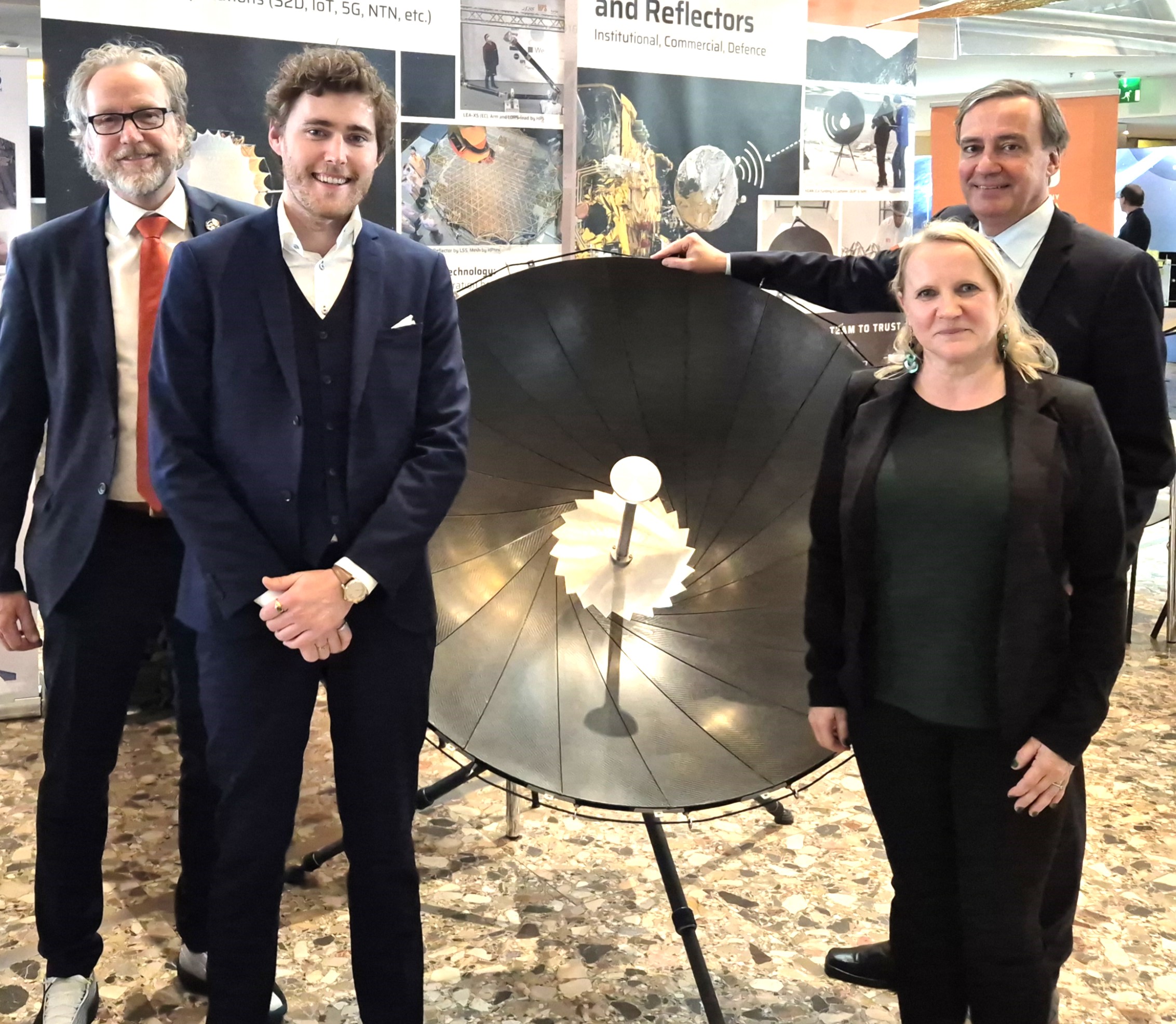
Development of the Compact Foldable Backpack Antenna by HPS Enters Final Phase with DLR Space Innovation Hub
März 2026







Development of the Compact Foldable Backpack Antenna by HPS Enters Final Phase with DLR Space Innovation Hub
März 2026
2016. The world of satellite communications is small, manageable, and mainly revolves around geostationary positions 36,000 kilometres above the Earth and enormous, permanently installed ground receiving stations. Only a handful of satellites for satellite telephony and navigation orbit in lower altitudes, tracing solitary paths above us.
During this period of apparent stagnation, HPS, the specialist in satellite communication antenna technology based in Munich, began developing a product far ahead of its time: KEAN, the compact, foldable backpack antenna for communication from anywhere in the world via satellite. The users: highly mobile units of both civil and governmental origin, as well as private sector stakeholders such as expedition leaders or correspondents for internationally operating media.
Over several phases, and with support from the ESA ARTES programme and the national DLR space programme, HPS, together with partners MTEX and BLACKWAVE, the Technical University of Munich and the University of the Bundeswehr Munich, developed a laboratory prototype with the following requirements:
Ultimately, the laboratory prototype in its KEAN II (Second Generation) version proved itself in rigorous link tests at the University of the Bundeswehr Munich, in connection tests with the German SatCom satellite Heinrich Hertz, as well as in handling tests in the field. As a result, the project’s goal is now within reach: the development of a prototype as a complete system for mobile, bidirectional satellite communication.
2026: In a final development step from KEAN II to KEAN III, further optimisation steps will now follow, which will ultimately establish the product’s suitability for series production. These range from design optimisation and further weight reduction to increased manufacturing precision for both individual pieces and series production, particularly in lightweight composite slats, as well as the complete combination and integration of modern and robust electronic components (modem, converter, amplifier), culminating in standardised acceptance tests for function and performance. These final improvements prior to product launch were commissioned on 21 April 2026 by the Space Innovation Hub funding programme of the German Aerospace Agency (DLR) and are to be completed within roughly 15 months with the delivery of a complete system for a final practical test by police special forces.
HPS CEO Ernst K. Pfeiffer: “We are especially proud that, with our innovation KEAN, one of the first contracts in what is expected to be a long list of upcoming development and delivery tasks was established through the new Space Innovation Hub funding programme of DLR with our company HPS. After many years of forward-thinking planning and patient, continuous improvements, we will be in a position in 2027 to serve the market for governmental and civil satellite communications with a perfect product just as the first major wave of demand begins. We thank the BMFTR in Berlin, the DLR Space Agency in Bonn, and the University of the Bundeswehr Munich for their support on our path to success.”